Yokes
A yoke is a shaped panel across the shoulders, the chest or back, or the hips, joined to the rest of the garment with a seam. Its main job is to keep the upper area smooth and close to the body while letting you release fullness below it, as gathers, tucks or pleats. The yoke seam can also hide a dart, so the visible darts can be smaller.
Where Yokes Go
| Yoke | Where It Sits | What It Does |
|---|---|---|
| Back (Shoulder) Yoke | Across the upper back, as on a shirt | Holds gathers or pleats below it. On a shirt it often reaches 1" (25 mm) onto the front. |
| Front Yoke | Across the upper chest of a bodice | Carries the dart and supports gathers or tucks over the bust. |
| Hip Yoke | The fitted top of a skirt | Controls the waist fit with no darts and supports a gathered, straight or circular skirt. |
Back yokes are cut the same way as front yokes. On a deep yoke you can leave the shoulder dart in. On a narrow one, fold the dart out so it disappears in the yoke seam.
Move the Dart to the Yoke Edge
A yoke works like a combination of horizontal and vertical darts. Don't just draw a yoke line over a flat pattern and cut it apart. The dart has to go somewhere, and if it stays put, the yoke edge has no ease and the design turns stiff and tight.
A yoke line laid over an untouched pattern has no ease along the seam. Move part or all of the dart to the yoke edge first.
- Draw the yoke line on the pattern. Curve it slightly instead of using a ruler.
- Connect the tip of the dart to the yoke line with a straight line, and cut along it.
- Pivot the pattern at the dart point to move part of the dart to the yoke, or all of it. Keeping a little of the waist dart is up to you.
- Tuck, gather or ease the extra along the top of the lower section into the yoke.
Fullness Beneath Yokes
Yokes provide a smooth, fitted anchor on the body while allowing soft gathers, tucks or pleats in the panel below.
- Isolate the Yoke: Draw the desired horizontal or curved yoke seamline across the bodice or skirt sloper.
- Transfer Yoke Darts: Absorb or rotate any dart intake inside the yoke area so the finished yoke piece remains flat and smooth.
- Spread the Lower Section: Cut slash lines through the lower panel. Depending on the design:
- Parallel Spread: Adds even gathers or pleating across the entire width.
- Flared Spread (Hinged at Hem): Adds fullness concentrated at the yoke seamline while keeping the hem circumference narrow.
- Match Alignment: True the seamline and place control notches on both the yoke and lower panel to establish gather boundaries.
Below is a front bodice with a waist dart. The yoke line is defined in red in the first image. In the second image, the waist dart has been moved to the yoke line. Two slash points have been defined and spread 1.5" (38 mm) each, creating the Flared Spread described above. The fullness is shown with the grey triangles. The waistline remains fitted, with all fullness concentrated at the top seam where the bodice connects to the yoke. The separate yoke pattern piece is shown in blue.
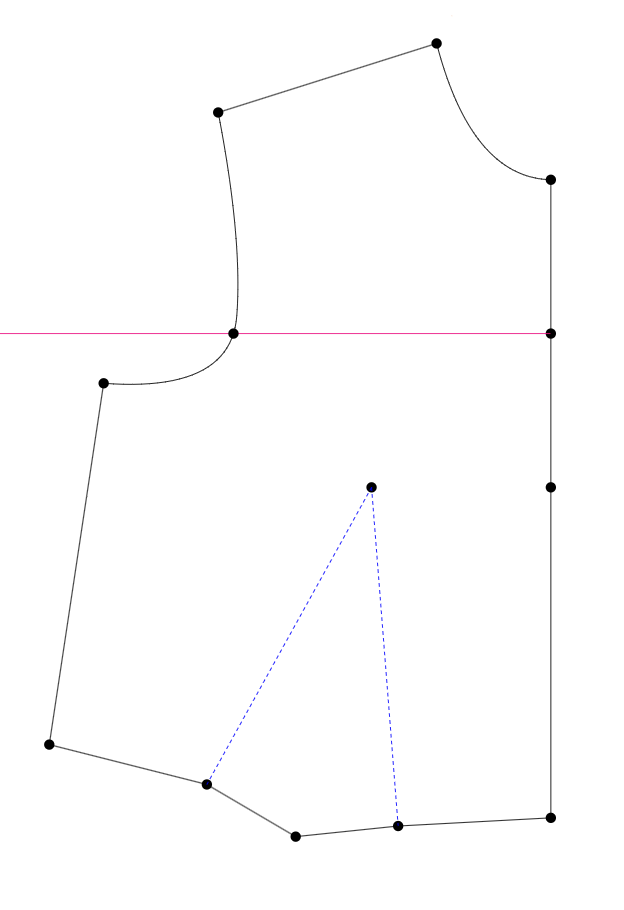
Defined Yoke Separation
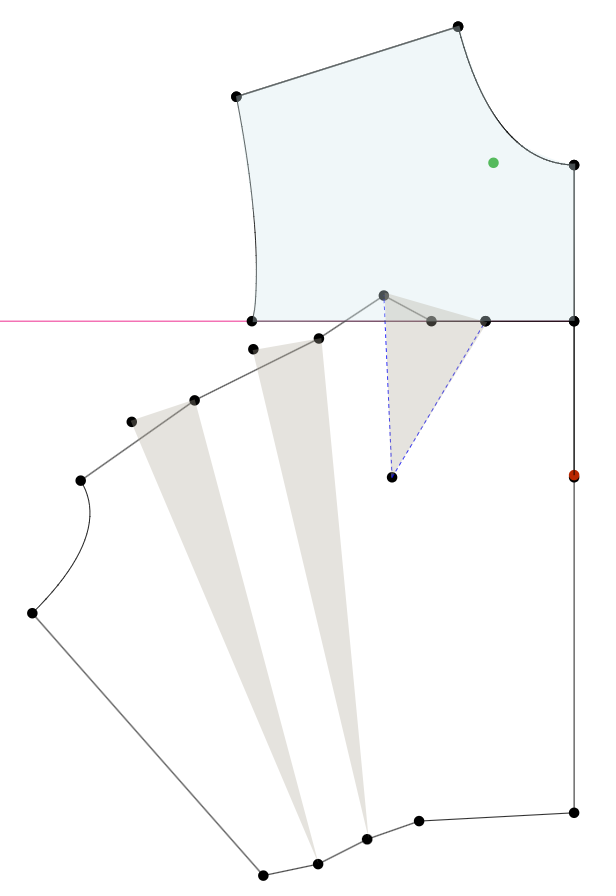
Dart Moved & 2 Slashes Opened at Yoke Line
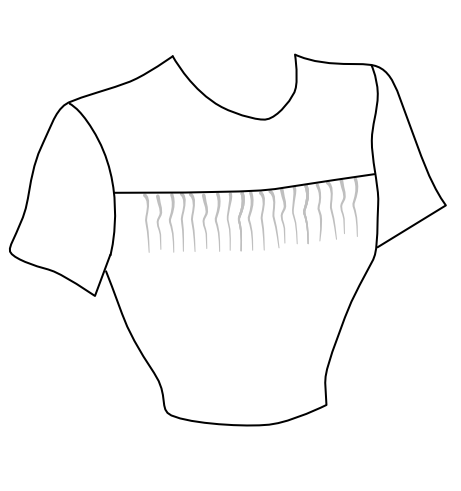
Yoke with Fullness Sewn
Start gathers no closer than 1" (25 mm) from the neckline and armhole, and use notches to mark where they begin and end.
- Slash direction: The folds usually fall where the slashes were cut. Slashes cut square to the yoke line run out into the armhole, and the gathers slant the same way.
- A smooth seam: Spreading slashes across a slanting yoke line leaves a jagged edge. Mark points midway between the high and low points of each section, then draw a smooth curve through them.
- A bloused look: Add length as well as width, so cut the lower edge of the yoke deeper.
Stripes, Plaids and Design
Grain matters on a yoke. On a striped shirt, a back yoke cut in one piece with the grain parallel to its back edge gives angled stripes at the front seam. Cut in two pieces with the grain parallel to the front edges, it gives a chevron at center back. Round yokes also look odd on stripes and plaids.
A few design points to keep in mind:
- Avoid equal divisions. A yoke that splits the bodice into even halves looks static.
- Deep, narrow yokes lead the eye up and down, while horizontal lines shorten the figure.
- Lines that look straight should still carry a slight curve, even a square yoke.