Fabric Properties
While a drafted pattern establishes a garment's silhouette, fabric choice is the critical first step that dictates necessary ease, dart placement, and seam orientation. Understanding fabric behavior ensures that the drafted dimensions on your flat pattern translate accurately to the body.
1. Structural Comparison: Woven vs. Knit Behavior
The primary mechanical difference between wovens and knits stems from yarn geometry.
| Mechanical Property | Woven Fabrics (Interlaced) | Knit Fabrics (Interlooped) | Pattern Drafting Impact |
|---|---|---|---|
| Basic Structure | Warp (lengthwise) and weft (crosswise) yarns crossing at 90° right angles. | Continuous yarns formed into intermeshing loops (courses and wales). | Wovens hold structural shape; knits mold fluidly around body contours. |
| Inherent Stretch | Rigid on straight grain; gives only along the 45° true bias (unless elastane is added). | Stretches structurally as loops deform under tension. | Wovens require positive wearing ease; knits utilize zero or negative ease. |
| Shaping Mechanics | Requires darts, seams, pleats, or gathers to shape flat planes around curves. | Conforms over curves through local loop deformation, often eliminating darts. | Knit bodices use simplified, dartless blocks with shallower armhole curves. |
| Edge Stability | Cut edges fray easily. | Edges do not fray, but single knits (jersey) tend to curl toward the face/back. | Hem and neckline allowances must account for fabric roll and edge finishing. |
| Grain Dynamics | Lengthwise grain is the most stable and carries the hanging weight. | Wales (vertical columns) must align vertically; poor stability leads to garment twisting. | Knit patterns require strict vertical grain orientation to prevent off-axis twisting. |
2. Grainline Mechanics & The Woven Bias
In woven garments, direction of cut dictates structural behavior:
- Straight Grain (Warp): Parallel to the selvedge. The strongest, most stable grain with virtually zero stretch. Carries the vertical hang of pants, skirts, and jacket front plackets.
- Crossgrain (Weft): Perpendicular to the selvedge. Carries slight mechanical give (yielding comfort across shoulders and chest).
- True Bias (45° Angle): The geometric diagonal across the warp and weft.
- Behavior: As bias is pulled vertically, the 90° yarn grid collapses, producing maximum fluid drape, natural elasticity, and body cling.
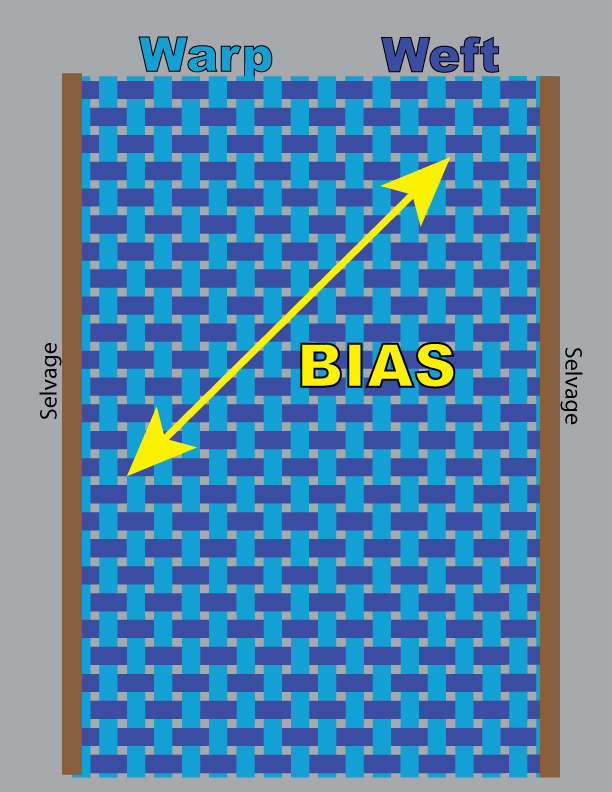
Warp and Weft
Bias garments stretch lengthwise under their own weight when hung. Armholes and hemlines must be drafted with reduced vertical length or left to hang for 24 hours prior to leveling and hemming.
3. Calculating Stretch Percentage and Recovery
Before drafting or adjusting patterns for stretch textiles, the fabric's usable stretch percentage and elastic recovery must be measured.
The Measurement Method
- Fold a test swatch along the crosswise grain (width, selvage at edges) at least 1" (25 mm) away from the cut edge.
- Mark a 4" (100 mm) test segment with two pins.
- Hold the left pin firmly against the zero mark of a ruler.
- Gently pull the right pin until the fabric resists or begins to distort/thin unnaturally. Note the stretched width.
Stretch Percentage = ((Stretched Length - Original Length) / Original Length) X 100
- Example: If a 4" swatch stretches comfortably to 5", (5 - 4) / 4, this equals 25% stretch.
- Example: If a 4" swatch stretches comfortably to 6", (6 - 4) / 4, this equals 50% stretch.
- Example: If a 100 mm swatch stretches comfortably to 125 mm, (125 - 100) / 100, this equals 25% stretch.
- Example: If a 100 mm swatch stretches comfortably to 150 mm, (150 - 100) / 100, this equals 50% stretch.
2-Way vs. 4-Way Stretch
- 2-Way Stretch (1-Direction): Stretches primarily in one direction (usually crosswise, around the body). Common in stable stretch wovens and basic t-shirt knits.
- 4-Way Stretch (2-Direction): Stretches both horizontally and vertically. Required for activewear, leotards, and form-fitting pants/leggings. Vertical pattern lengths must be reduced alongside horizontal widths.
Evaluating Elastic Recovery
Stretch without recovery leads to bagging at knees, elbows, and seats:
- Perform the stretch measurement test above and release the stretched swatch.
- Remeasure the 4" pinned section after relaxing for 10 seconds.
- If the fabric measures 4-1/4" (108 mm) or more after release, it possesses poor recovery.
Do not draft with high negative ease on low-recovery fabrics (such as 100% rayon or modal knits), or the garment will permanently stretch out during wear.
4. Fabric Weight & Drape
| Fabric Characteristic | Structural Behavior | Drafting Modifications Required |
|---|---|---|
| Heavy / Structured (Denim, Wool Melton, Canvas) | Resists folding; forms clean, rigid planes away from the body. | • Increase armscye and crotch depth to allow joint movement. • Use wider seam allowances (1/2" to 5/8" (13 mm to 16 mm)). • Avoid narrow gathers; use crisp knife or box pleats. |
| Light / Fluid (Silk Chiffon, Rayon Challis, Modal) | Collapses inward; conforms to contours under gravity. | • Reduce style ease to prevent drowning the silhouette. • Raise armhole depth to prevent hem lift. • Use narrow seam allowances (1/4" to 3/8") or French seams. |
| Lofty / Bulky (Fleece, Quilted Cloth, Chunky Knits) | Internal thickness takes up more space. | • Add 1/4" to 1/2" (6 to 12 mm) extra circumference to compensate for interior wall thickness. • Enlarge buttonholes by adding total button thickness. |