Cowl Necklines
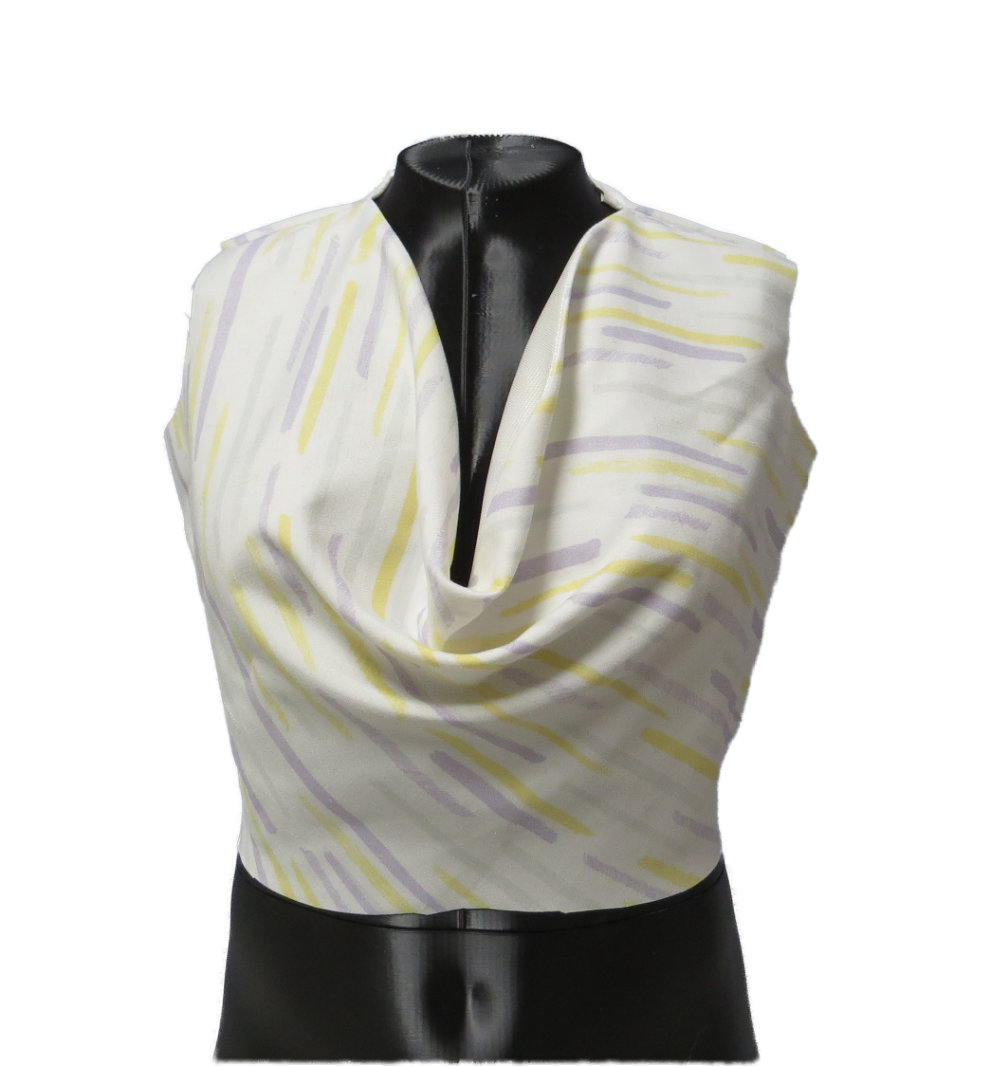
Deep Cowl Sample Garment (1/2 scale)
A cowl is a neckline that falls in soft folds. Two things decide how it looks:
- Neckline Depth: how far the cowl drops, and how long each fold is.
- Fabric Bulk: how many folds form, and how softly they hang.
Woven fabric drapes most softly along its diagonal, so you cut the cowl part of the bodice on the true bias. Cowls hang best in soft, loosely woven fabrics such as crepe, chiffon, silk, gauze and rayon, and in some knits.
The steps for drafting a cowl in PatternMaker Pro are in the Cowl Neckline instructions.
How Deep Is the Cowl?
A cowl gets its fullness from the bust dart. The deeper the cowl, the more dart excess it takes, and because a bias cut stretches over the bust, you can reduce the body darts or leave them out.
| Cowl | Where It Falls | Dart Excess Used |
|---|---|---|
| High | Just below the throat | Some of it |
| Mid-Depth | Between the neck and the bust | About half |
| Low | At or just below the bust | All of it |
Draft by Hand
If you are drafting without PatternMaker Pro, use an L-square:
- Align the Square: Place one arm on the side neck point and the other arm along the center front line, level with the bust apex.
- Set the Depth: The distance from the side neck point to the corner of the square is your cowl drop. For a single drape, about 4" (10 cm) is a common depth.
- Go Deeper (Optional): For a deeper cowl, move the center front arm below the apex, as far down as the center waist point.
- Open the Neck: First take at least 1" (2.5 cm) off the shoulder where it meets the neck, so the folds have somewhere to sit.
Start with the Vertical Center Front Control
Before you draft the drape, move the bust dart intake to the center front. This gives you a Vertical Center Front Control: a transitional pattern, not a wearable block. With the dart intake at the center, you have a clean pivot point for cowls of any fullness.
Comparing Vertical Center Front Control to Basic Sloper
Cowl Variations
At the top edge of any cowl, the extension point must make a clean 90° angle between the center front fold line and the side neck point. Otherwise a point or a hollow forms at the center when the pattern is cut on the fold.
Cowl 1: High Neckline
A subtle cowl that uses only the dart intake you already have, with no extra fullness.
- How: Redraw center front straight up from the waist, past the center front neck point. The volume that would close into a dart goes into the neckline instead.
- Fit: The neckline stays high and the fit stays close through the midriff and waist. A soft roll forms just below the throat.
- Grain: Set the grainline to the true bias so the drape breaks naturally.
Cowl Design Number 1
Cowl 2: Mid-Depth Drape
More fullness than the dart alone gives you, dropping the drape across the bust.
- How: Measure out from the relocated apex point, for example 1" (25 mm). Pivoting from this offset point lowers the folds so they sit across and below the bust line.
- Fit: A moderate drape that shows more of the upper chest and skims the lower torso.
Cowl Design Number 2
Cowl 3: Deep Plunge Drape
The most drape, with folds falling well below the bust.
- How: Decide how deep you want it, and measure on the body from the side neck point down over the bust to that depth. On the flat pattern, this is the distance from the side neck to the top point and center front.
- Fit: A dramatic, fluid drape. Because the neckline drops below the bust line, it usually needs a modesty underlay, an inset camisole or a lining.
Cowl Design Number 3
Test the Drape
A bias cut stretches and hangs differently from the straight grain, so a cowl pattern needs a test before you cut good fabric.
- Find True Bias: Fold the fabric so a crosswise edge lines up with a lengthwise edge, and mark the diagonal fold. That is your true bias.
- Drape It: Cut the pattern in muslin on true bias and pin it to the form. Let the fabric fall and stretch, then mark the outline of the form on it.
- Correct the Pattern: Measure the difference between the pattern and the marked outline, then adjust the pattern to match and recut.
Drafting for Knits
A knit does not need a bias cut. Cut it on the straight grain, though a bias cut works too. Other things to keep in mind:
- Reduce Cowl Depth: Knits stretch under their own weight. Draft the drop a little shallower than you would for a woven, so the neckline does not sag too low.
- Skip the Dart Step: Knit blocks usually have little or no bust dart intake, so you can draft the cowl directly.
- Stabilize the Shoulders: Reinforce the shoulder seams with clear elastic, stay tape or twill tape. The weight of the folds pulls forward against the shoulder line.
- Fabric Choice: High-drape knits (rayon or viscose jersey, modal, bamboo, fine silk or wool jersey) give the softest folds. Dense or high-recovery knits, such as sturdy ponte or heavy cotton-spandex, stand away from the body in stiff folds.
Design Options
- Sleeveless: Narrow the shoulder from the outer shoulder point inward. This gives the folds room to drape across the collarbone without pulling or gaping at the armhole.
- Wider Neckline: Trim the shoulder line at the side neck point before you draft the cowl. Make the same change on the front and back so the neckline opens evenly.
If you change the front shoulder line, change the back to match, or the shoulder seams will not line up for sewing.
Cowl Facings
- Cut It in One: The facing is often part of the bodice piece itself, turned to the inside. Leave the fold soft: do not crease or press it. A small weight, covered in fabric and attached to the center edge, helps hold the drape.
- Make It Deeper at Center Front: On very fluid fabric, a facing that is larger at center front is less likely to roll to the outside.
- Match the Drop: A deeper cowl needs a longer facing to keep the inside edge finished.
- Separate Facing: To make a separate facing, detach the piece and add seam allowances to both the facing and the cowl edge. It can be a lighter or contrasting fabric.