Pleats, Pin Tucks, Flanges
Pleats, tucks and flanges are all folds. Each one takes fullness out of a flat piece of fabric and puts it exactly where you want it. That makes them a more controlled way to add volume than gathers.
Pleats
A pleat is a fold that releases fullness. One pleat gives a straight skirt room to stride. A group of pleats can be a design all on its own.
| Pleat | How the Folds Turn |
|---|---|
| Knife (Side) | All folds face one direction. |
| Box | Two folds turn away from each other on the right side. |
| Inverted | Two folds turn toward each other and meet on the right side. |
| Accordion | Narrow, even pleats from waist to hem. Usually done by a professional pleater. |
| Sunburst | Pleats fan out and widen from the waist, on circle skirts. |
| Kick | A short pleat at the hem of a skirt, for walking room. |
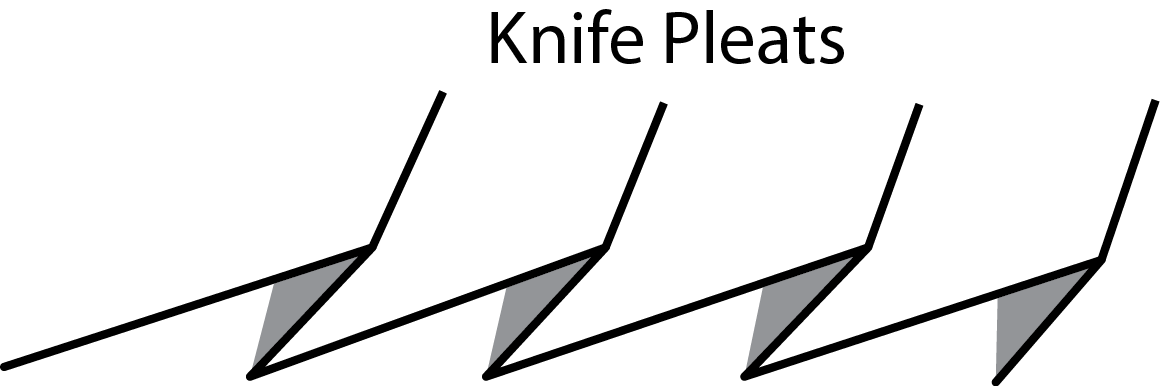
Knife pleats: every fold turns the same way.
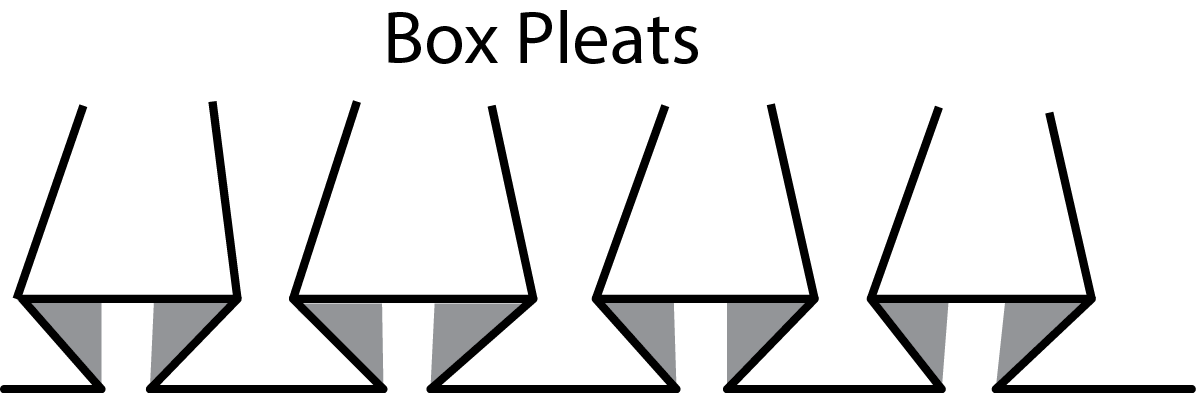
Box pleats: two folds turn away from each other.
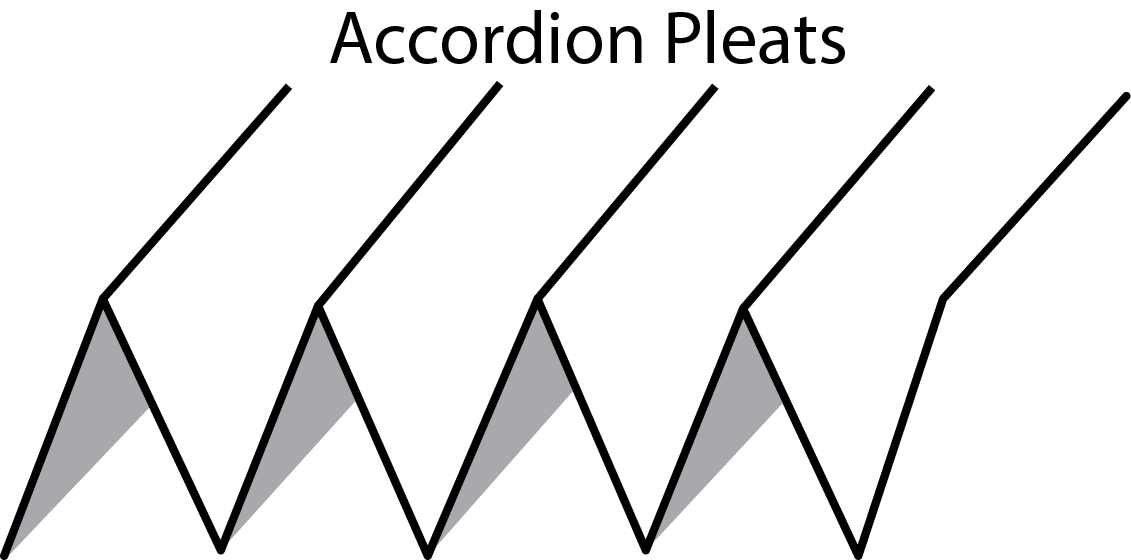
Accordion pleats: narrow, even folds.
Pleats involve ironing in sharp edges. They are not suitable to synthetics that don't hold a crease.
Pleat Terms
- Depth: The distance from the outside fold to the inside fold.
- Underlay: The fabric that forms the pleat, always twice the depth. A 2" (5 cm) depth needs a 4" (10 cm) underlay.
- Spacing: The distance between one pleat and the next.
Pleat patterns use three kinds of line. A fold line marks a sharp crease, a roll line marks a soft, unpressed fold, and a placement line shows where the fold is brought to. See Pattern Markings & Annotations for how these are marked.
Drafting Pleats
Draw the pleats on a pattern the same way you spread fullness: slash the pattern, spread it by the pleat amount, then fold the pleats closed and true the edge. Fold the pleat nearest the side seam first.
For a kick pleat, mark the top of the pleat, say 8" (20 cm) up from the hem at center front. Square out the pleat depth, for example 2" (5 cm), and repeat at the hem. Add 1/2" (13 mm) along the center line for pleat control. Stitch the fold closed or leave it open as a vent.
A simpler rule of thumb says pleating takes about three times the finished width. Your own numbers will land between the two, depending on pleat depth and spacing.
A seam can hide in the back fold of a pleat, where it will not show. This helps when the pleated piece is wider than your fabric.
Fabric for Pleats
Pleats hold best in springy fabrics that still drape well. Wool and wool blends, silk, cotton blends and most synthetics all work. On permanent-press fabrics, edgestitch the folds for a sharp edge. If you do not want to pleat a whole skirt yourself, professional pleaters will pleat accordion and knife pleats to fit your measurements.
PatternMaker Pro: Add Construction Detail tool
Pin Tucks
A tuck is a slim fold, stitched for part or all of its length. Fold decorative tucks on the outside of the fabric. There are three kinds: blind tucks that touch or overlap, spaced tucks with a set gap, and pin tucks, which are very narrow and closely spaced.
Pin tucks suit light, flat fabrics, such as organdy, lawn, voile and chambray. Make them in a piece of fabric before you cut, so the fold stays true in width and grain.
To draft them, plan the first line near the center front, then draw parallel lines. For a bib, for example, draw the first line 1/16" (2 mm) from the center front and the others 1/4" (6 mm) apart, with a tuck intake of 1/8" (3 mm). Fold the paper along each tuck, trace the pattern shape, then cut and unfold.
Released tucks, or dart tucks, work the other way. The fold goes on the inside, is stitched to a point, then released. They shape the fabric like darts and should point toward the fullest part of the body.
Flanges
A flange is a strip of fabric that carries on from the garment's edge. You can cut it in one with the garment, or sew it in as its own piece along a style line. It can go almost anywhere on a garment.
At the shoulder, a dart flange can be folded as a pleat, or stitched part of the way as a tuck-dart to control fullness. Fold it toward center front.